For most of my career the organising question in economics has been where something can be made cheaper. Supply chains, offshoring decisions, trade agreements and, by extension, a good deal of the equity market’s leadership over the past two decades were all answers to that one question.
Over the past eighteen months senior American officials have started answering a different question, which is what happens if a country cannot get something at all. They have given the shift a name, and the name is two hundred and thirty-five years old.
Once a government decides it would rather be able to make something than buy it cheaply, it has committed itself to a long sequence of consequences, and those consequences are legible in advance. It will bid for physical inputs. It will accept higher prices. It will need suppressed real rates to fund the attempt. It will lean on allies and punish holdouts. Every one of those steps has an asset attached to it.
I should be clear at the outset about what this does not require. It does not require reindustrialisation to succeed. I am perfectly happy to take the pushback that America cannot rebuild an industrial base it spent forty years dismantling, and there are good arguments on that side. That is beside the point I am making. The resources will be committed either way, and the commitment is what you are positioned against. More money is made in the journey than at the destination.
What Hamiltonian economics actually is
In January 1790 the House of Representatives asked Treasury Secretary Alexander Hamilton to examine how the United States could be rendered independent of other nations for essential supplies. He delivered his answer, the Report on the Subject of Manufactures, in December 1791. That single instruction from the House contains the whole framework.
Hamilton proposed four tools. Protective tariffs to shelter young industries from established foreign competitors. Direct subsidies, which he called bounties, funded out of other government revenue. Patents to reward invention. And publicly funded transport and infrastructure. He was explicit that bounties were the better instrument and that tariffs were partly a way of raising the money to pay for them.
Underneath the toolkit sits a rejection of something most of us were taught as settled. The Ricardian view is that a country should produce what it is best at today and buy the rest from whoever makes it cheapest. Hamilton’s counter-argument was that a country dependent on a foreign supplier for essential goods is not secure however good the price, and that a new industry cannot survive a direct fight with a mature foreign one, so the state should carry it until it can.
Luke Gromen of FFTT compresses this better than anyone I have read. He describes neoliberal globalism as being about getting prices right and Hamiltonian economics as being about “getting prices wrong in service of a greater national strategic imperative.”
Two cautions. Hamilton was writing for a young debtor nation with almost no industry, a hard-money system and Britain as the incumbent power. Very little of what is happening now is a literal revival of his programme. The second caution is that not every subsidy is Hamiltonian. A government handing money to a favoured firm is ordinary politics. It becomes Hamiltonian when the stated objective is national capability in a named strategic sector and the state is prepared to accept a worse price to get it.
Who is saying it, and when they started
What makes this worth an investor’s attention is not that the analogy is appealing. It is that officials began using it themselves, in prepared remarks, on the record.
On 20 January 2026, at Davos USA House, U.S. Trade Representative Jamieson Greer delivered a speech titled “The Hamiltonian Economic System That Too Many Have Forgotten.” He argued that the traditional American approach to economic policy had historically combined tariffs, state support for domestic industry, and strategically structured trade, rather than relying on unrestricted free trade. Greer presented the Trump administration’s trade policy as a revival of this Hamiltonian “American System.”
Five months later, on 23 June, Treasury Secretary Scott Bessent addressed the Economic Club of New York’s America 250 gala dinner and defined economic statecraft as the disciplined use of American economic power in service of sovereignty. He invoked Hamilton directly, quoting the line that every nation ought to endeavour to possess within itself all the essentials of national supply, and he named the sectors: semiconductors, AI, quantum computing, advanced manufacturing, shipbuilding, critical minerals and pharmaceuticals.
Economic security begins with national capacity. American openness will be matched by reciprocity. America will write the rules of the next economy. Financial leadership is a central instrument of statecraft. And economic statecraft must serve the American people.
The fourth is the one most investors are underweighting. Treasury is stating plainly that the dollar’s international role is something to be actively maintained rather than passively inherited, which is a very different proposition from the last thirty years.
Michael Every of Rabobank prefers a different label and is right to insist on it. Speaking to Adam Taggart on Thoughtful Money, he argued that mercantilism means deliberately running a trade surplus in order to accumulate gold, and that what we are watching is better described as economic statecraft, meaning the coordinated use of every instrument of the state towards an economic goal. The United States still runs a very large trade deficit. Calling this mercantilism overstates it, and the distinction tells you the objective is capability rather than accumulation.
Three things that follow immediately
You start following governments rather than earnings calls. Federal outlays alone are 23.3 per cent of US GDP this year according to the Congressional Budget Office, and total government spending across most of the developed world sits comfortably above a third of GDP. In an environment where the state is setting prices in strategic sectors, the Treasury Secretary’s speeches matter more to my positioning than any chief executive’s guidance. I have been saying for four years that the only thing worth following is the government.
You start looking at nominal GDP rather than real. If prices are being deliberately set wrong, the deflator is doing policy work, and real growth stops being the variable that determines returns. This matters well beyond America. Indian equities have been difficult for two years, and the reason is visible in nominal GDP decelerating rather than in anything companies did. You cannot pay the same multiple for an economy whose nominal growth rate has fallen by a third.
You start treating fiscal policy as the primary and monetary policy as the follower. This is the practical meaning of fiscal dominance. Gromen defines it as gross interest expense plus entitlement outlays as a percentage of federal receipts, and argues that the system reacts predictably whenever that figure approaches ninety-five per cent. I use a simpler test. The CBO projects a deficit of 5.8 per cent of GDP in 2026 and net interest of 3.3 per cent of GDP, with debt held by the public at 101 per cent of GDP this year and passing the post-war record of 106 per cent within the decade. A government carrying that load cannot afford sustained positive real rates, so it will not have them for long.
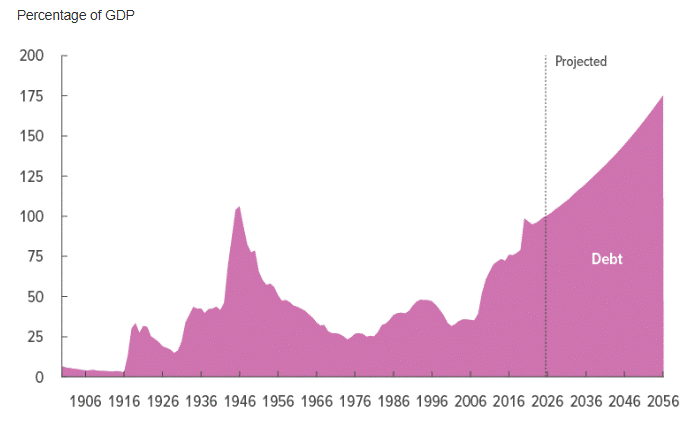
Source: Congressional Budget Office, The Long-Term Budget Outlook: 2026 to 2056, March 2026.
The post-war comparison is the one worth sitting with, because the last time American debt was at these levels, the government did not default or pursue conventional austerity. From 1942 to 1951, the Fed kept interest rates below inflation and capped long-term Treasury yields at 2.5%, allowing nominal growth and inflation to reduce the real burden of the debt while fiscal policy and strong private investment supported a broad industrial expansion.
The evidence, country by country
The United States: On tariffs, the Supreme Court held on 20 February 2026, six to three, in Learning Resources, Inc. v. Trump, that the International Emergency Economic Powers Act does not authorise the President to impose tariffs. The Court of International Trade has since ordered Customs and Border Protection to refund roughly $165 billion. Most commentary read this as the end of the programme. What followed is more informative. The administration moved to Section 232, Section 301 and, on 20 July, to Section 338 of the Tariff Act of 1930, which no president had used before. Section 338 has no statutory expiry and permits the President to bar covered goods from importation entirely. The court narrowed the instrument and pushed the policy onto ground that is harder to unwind.
On bounties, the template is the Department of Defense arrangement with a domestic rare earth producer agreed in July 2025. A guaranteed floor price of $110 per kilogram for neodymium-praseodymium over ten years, structured as a contract for difference, with the government taking thirty per cent of any upside above the floor and a preferred equity stake that made it the largest shareholder. The state is not writing a grant. It is removing price risk so that private capital will fund the capital expenditure, which is Hamilton’s bounty argument executed with a modern balance sheet.
The scale of what is being attempted is worth stating plainly. US manufacturing value added was sixteen per cent of GDP in 1997 and 9.5 per cent in the third quarter of 2025. Reversing even part of that on a twenty-nine trillion dollar economy is an enormous mobilisation of physical resources.
China: the mature version. The most important thing to understand about the Chinese case is that it came first. The outline of the 15th Five-Year Plan, covering 2026 to 2030, was approved in March. Five-year plans in China are not merely aspirational documents; they provide the framework for government policy, resource allocation and implementation, shaping budget priorities, local-government objectives and official performance incentives. The plan makes a substantial strengthening of scientific and technological self-reliance a core objective and commits to national R&D spending growing by more than seven per cent annually. Most consequentially for the rest of us, it places strategic minerals, including rare earths and rare metals, firmly within China’s long-term strategy for technological and industrial security, building on export controls that Beijing had already begun institutionalising.
That last point deserves significance. The instrument the United States is now reaching for in critical minerals is the instrument China has been using on the United States. Gromen makes the historical version of this argument, and I find it clarifying: China today is doing to America roughly what the young America did to Britain, which is to use state-directed acquisition of foreign industrial technology to build a domestic base, and the rising power always uses the tools the incumbent later disavows. If you want to see this framework at maturity rather than in its first year, look at Beijing rather than Washington.
Japan: the largest bet relative to the size of the economy. Japanese semiconductor subsidies have reached tens of billions of dollars since 2021, making Japan’s programme unusually large relative to GDP. The centrepiece is Rapidus, a heavily state-backed venture aiming to mass-produce two-nanometre logic chips in Hokkaido from 2027. By April 2026, government R&D assistance to Rapidus had reached roughly ¥2.35 trillion, with further government equity investment and support planned.
Japan is the cleanest illustration of the argument, and also of its risk. Public support for Rapidus now represents a substantial share of the estimated investment required to reach mass production, while the company is attempting to compete with the world’s leading advanced foundries. The objective is not simply to obtain chips at the lowest possible cost. Japan is effectively paying an insurance premium for domestic advanced-semiconductor capacity in case geopolitical or supply-chain disruptions make foreign supply unreliable. Whether the fab ultimately earns an adequate return on capital is a separate question from whether the government succeeds in creating the capacity.
Korea: the same logic, written into law earlier. Korea passed its Special Act on national high-tech strategic industries in 2022, which designates strategic items and attaches tax benefits, regulatory relief and preferential treatment to firms producing them. It has since been expanded. Korea has also committed to higher defence spending. What makes Korea and Japan a different kind of participant is that both are creditors to the United States. Gromen’s observation here is one of the more uncomfortable in the whole framework. If Japan has to sell Treasuries to defend the yen, the United States is the party that suffers, which means American policy is now partly hostage to Japanese policy. Any country that receives a dollar swap line in a crisis is being told it is inside the tent, and that is worth watching as a signal of who the Americans consider to be in their bloc.
Europe: real, and slower than it looks. This one requires care, because Europe does industrial policy constantly and most of it is not Hamiltonian. Subsidising a national airline is politics. Three things do qualify.
The first is defence. The ReArm Europe plan, now branded Readiness 2030, aims to unlock around €800 billion of additional defence spending, partly by activating the national escape clause of the Stability and Growth Pact so member states can borrow for it, with roughly €150 billion channelled through the SAFE instrument. Germany’s reform of its constitutional debt brake to exempt defence spending is the single most important fiscal decision taken in Europe in twenty years. These are borrowing decisions taken because the American security guarantee is no longer assumed, which is capability purchased at a worse price for strategic reasons.
The second is critical raw materials. The Critical Raw Materials Act sets binding 2030 benchmarks for domestic capacity: ten per cent of annual needs from EU extraction, forty per cent from EU processing, twenty-five per cent from recycling, and no more than sixty-five per cent of any strategic raw material at any processing stage from a single third country. The provision is particularly relevant to Europe’s dependence on China, without naming China explicitly.
The third is the Draghi diagnosis itself, which argued the productivity gap with the United States was existential and would require public and private investment of close to five per cent of European GDP to close.
The honest caveat is execution. The European Court of Auditors has described the target of supplying twenty per cent of the world’s semiconductors by 2030 as essentially aspirational, and joint defence procurement in most member states is still below twenty per cent of the total. Europe has the policy and the diagnosis. It has a fragmented capital market, an ageing population and an energy cost problem standing between it and the result. That is why I would rather own the demand Europe creates than Europe’s broad equity market.
India: the framework under a different name. India has been running Hamiltonian policy for five years without using the word. The Production Linked Incentive schemes cover fourteen sectors with an outlay of about ₹1.97 lakh crore and had attracted around ₹2.16 lakh crore of reported investment by the end of 2025. The India Semiconductor Mission committed ₹76,000 crore and had approved semiconductor projects involving around ₹1.6 lakh crore of investment by December 2025. Electronics has climbed rapidly up India’s export rankings and is now among its largest export categories. Named strategic sectors, bounties, an explicit self-reliance objective. That is the framework.
The nuance matters as much as the headline. Fund utilisation under the initial semiconductor programme was relatively low, and the FY27 budget allocation for PLI was set slightly below the revised FY26 figure. India is executing the policy rather than accelerating it. My own view on India, which I have written about for years, is that the four things worth owning are electrification, defence technology, engineering and wealth management, and that they are worth owning because of the direction of government policy rather than despite it.
Indonesia: the case study in what can go wrong. Indonesia banned raw nickel ore exports outright on 1 January 2020, two years ahead of its own deadline, under a policy known as hilirisasi. The logic was pure Hamilton. Stop exporting the ore and force the processing to happen at home. It worked in the narrow sense. More than $30 billion of foreign investment, mostly Chinese, went into domestic smelters and refineries. Export values rose sharply. In April this year President Prabowo broke ground on thirteen new processing projects, and the state investment vehicle Danantara is coordinating eighteen downstream projects worth roughly $35-37 billion. Jakarta has also cut the national nickel ore quota to around 250 to 260 million wet metric tonnes for 2026, down from 379 million tonnes, and has proposed a state agency to handle export sales of certain commodities.
Now the parts that are usually left out. The European Union took Indonesia to the World Trade Organization over the export ban and won at the panel stage. Indonesia appealed the ruling, leaving the dispute unresolved. Much of the increase in export value came from volume and price rather than from moving up the technology curve, and the processing that was built runs on Chinese technology and Chinese capital, which means Jakarta has substituted one dependency for another. Meanwhile the battery market has shifted toward chemistries that use less or no nickel, particularly LFP in China, illustrating the broader risk that policy-driven commodity scarcity can encourage substitution and innovation elsewhere.
Indonesia is the most useful case in this whole section, because it shows the framework working and failing at the same time. The capital gets committed. The smelters get built. Whether the country captures the value is a separate question, and the answer so far is only partly. For an investor that distinction matters less than it should, because the commodity demand is created either way.
Argentina: the exception that keeps me honest. Not everyone is doing this. Argentina under Milei has moved in the opposite direction, deregulating and opening rather than protecting and directing. We own Argentina, and I want to be clear that we own it for a completely different reason. That position is a normalisation trade in a country coming off an extreme starting point, not an expression of this framework. If I labelled every government intervention Hamiltonian and every country a participant, the framework would explain everything and predict nothing.
Canada. The most instructive case, and the one that is live this week.
Canada, as of this morning
Canada matters because it is the least likely target. A treaty ally, a CUSMA partner, and the closest thing the United States has to an integrated industrial hinterland.
Start with the piece that got least attention. On 1 July the CUSMA Free Trade Commission conducted the first six-year joint review of the agreement, and the United States did not agree to extend it for another sixteen-year term. CUSMA remains in force until 2036, but the parties must now conduct a joint review every year unless they later agree to extend. North American trade has gone from a treaty with a long horizon to an arrangement that gets re-litigated annually. For anyone allocating capital to cross-border supply chains, that is a bigger change than any single tariff rate.
Then the tariffs. On 20 July, three presidential proclamations imposed an additional fifty per cent duty on a list of Canadian goods under Section 338, covering roughly twenty billion dollars of American imports from Canada, about five per cent of the total. The duties were initially scheduled to take effect on 19 August but were delayed to 22 August. The stated grounds included Canada’s twenty-five per cent surtax on US-origin motor vehicles. Energy, potash and goods already under Section 232 were carved out, which tells you the exclusions were drawn around inputs the American economy genuinely needs.
Four days later, on 24 July, a separate Section 301 action took effect against sixty economies including Canada, following a USTR finding that they had failed to prohibit or effectively enforce bans on imports made with forced labour. The rate is ten per cent for countries with some form of prohibition and twelve and a half for the rest. CUSMA-compliant Canadian goods are exempt. Different statute, different justification, same direction.
The 50 per cent duties slipped from 19 to 22 August while negotiators worked in Washington. Reporting at the time indicated the Americans had offered to lower tariffs on steel, aluminium and cars in exchange for greater access to Canadian dairy and lumber markets. Carney walked away, saying late changes to the American terms were unfair and uneconomic. The duties took effect on 22 August. Speaking that weekend he said his government had understood before most that America would transform all its commercial relationships and would “use economic integration as a weapon,” and that the gap between partner and competitor had remained too wide.
On 25 August, Ottawa published its response. Counter-tariffs of fifteen, twenty-five and fifty per cent across 629 tariff lines covering C$27.6 billion of American goods, roughly $19.9 billion, matching the American measures dollar for dollar, with certain existing 25 per cent rates rising to 50 to mirror the US. The targets are steel, dairy, appliances, agricultural equipment, pulp and paper and electronics. Alongside it came a C$7.5 billion support package for affected businesses. Those counter-tariffs take effect tomorrow, 8 September.
As I write this on Monday morning, there is no sign of a deal that stops them. That may change by the time you read it, and I would not put much weight on any single outcome this week. The pattern matters more than the print.
The lesson is not about who is in the right. A country willing to do this to Canada will do it to anyone, and the rational response of every target is to build alternatives. Carney has spent eighteen months seeking trade and security arrangements elsewhere and has argued that middle powers should coordinate as a counterweight. That is the pattern to extrapolate, and it compounds. Each application of American leverage creates a permanent incentive somewhere else to reduce exposure to it.
Politics is now a first-order input
I would normally keep domestic politics out of a macro piece. In this environment that would be an error, and last Friday made the case better than I could.
Reacting to a stronger than expected August payroll number, the President posted on Truth Social demanding that the Federal Reserve cut rates. If it did not, he wrote, he would “STOP TRADING WITH COUNTRIES WITH WHICH WE HAVE A DEFICIT,” describing this as better than tariffs and citing the Supreme Court’s February decision as having acknowledged his right to do it. The post was addressed to the Fed Board and to Kevin Warsh.
Set aside whether the threat is executable. Note what it reveals. Trade access, monetary policy and the tariff programme are being treated as one instrument with one operator. That is precisely Every’s definition of economic statecraft, and it is Bessent’s fourth principle without the diplomatic packaging. Markets have learned to discount these posts. I think that is a mistake, because the direction of travel in the posts has repeatedly turned out to be the direction of travel in the policy, several months early.
The midterms are in November. Tariffs raise prices and inflation has been the dominant political complaint of this cycle. A Congress hostile to the programme, combined with a Court that has already shown the legal foundations are contestable, is a real risk to the framework. It is also, judging by the Section 338 pivot, a risk the administration is already engineering around.
The contradiction nobody has resolved
Gromen’s central argument is that you cannot run a Hamiltonian economy and a fully open capital account at the same time. Protecting industry requires getting prices wrong. The dollar’s reserve role as constructed since 1971 requires free capital flows and a financialised economy that recycles foreign surpluses into American assets. He thinks the choice is being deferred rather than made, and that the eventual resolution involves settling deficits in gold at a much higher price.
I accept the contradiction. I am less certain about the resolution, and this is where I part company with him.
Two competing architectures are being built simultaneously. One is a gold settlement system, with China reintroducing gold into trade and opening vaulting capacity across Asia and the Gulf. The other is a dollar stablecoin system designed to create structural demand for Treasury bills.
The stablecoin leg is more interesting than the coverage suggests, and it is worth being precise because a lot of what is said about it is wrong. Section 4(a)(11) of the GENIUS Act prohibits permitted issuers from paying any form of interest or yield to stablecoin holders. The issuer earns the Treasury bill income on the reserves and cannot pass it on as interest or yield to the holder. Whether exchanges and affiliates can do indirectly what issuers cannot do directly has been a central unresolved question, and the OCC has proposed rules that would create a rebuttable presumption against certain affiliate and related-third-party arrangements designed to provide such yield. The treatment of rewards and indirect yield also remains a significant point of contention in the wider market structure legislation.
Read that structurally and it is a Hamiltonian instrument. A foreign exporter holds a dollar claim that pays nothing, the reserve income accrues inside the American financial system, and the Treasury acquires a captive bid at the front end. It also creates an off switch. A claim that lives on a permissioned ledger can be frozen in a way that a banknote in Caracas cannot. That is the reciprocity principle rendered in software.
What I am confident about is the direction of pressure rather than the endpoint. Reindustrialisation means moving capital into businesses with structurally lower margins than the financialised economy that American capital has grown used to. It requires suppressed real rates to be financeable. It requires tariffs, duplicated supply chains and rearmament, all of which raise costs. Every one of those is inflationary at the margin, and every one is worse for a long-dated claim on a currency than for a physical asset.
How this becomes a portfolio
A state that has decided it must be able to make things has to buy physical inputs, and it has shown it will set the price to get them. That is the argument for real assets, and it is the largest block in the fund. Precious metals span bullion and miners, including small positions in platinum and palladium. Industrial metals and materials are centred on copper. Energy and uranium are split between producers, broad energy and physical uranium. Agriculture also forms a smaller allocation. Gold sits inside this for a related but distinct reason: when a government is prepared to distort prices, the asset that is nobody’s liability becomes the reference point. The European Central Bank’s June 2026 report put gold at twenty-seven per cent of total official foreign reserves at the end of 2025, ahead of US Treasuries at twenty-two and the euro at fifteen. Gold has overtaken Treasuries.
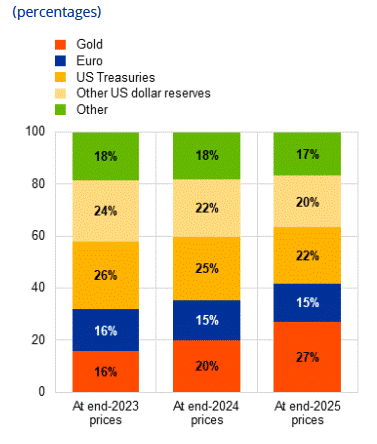
Source: European Central Bank, The international role of the euro, June 2026, Chart 7, panel a).
The ECB is careful about why, and so should we be. Most of that move is the gold price rather than reallocation. Correct for it by valuing gold at the end-2023 price and the picture changes: gold and the euro sit level at sixteen per cent each, with US Treasuries still well ahead at twenty-six. The chart above shows both versions side by side, which is the honest way to present it.
The more interesting question is whether the buying behind it is still happening. Official sector purchases ran above a thousand tonnes a year from 2022 to 2024 and eased to around 850 tonnes in 2025, which is still far above pre-2022 norms despite record prices. Since Russia’s invasion of Ukraine, China has bought over 350 tonnes, Poland 320, Turkey 220 and India 130. Poland was the largest buyer in 2025 at around 100 tonnes.
Two details from the same report are worth more than the headline. The first is that Tether, the stablecoin issuer, bought more than 100 tonnes of gold in 2025, which is more than any central bank. The second is that the value of US Treasuries held in custody at the New York Fed for official institutions fell by $82 billion to $2.7 trillion in March 2026, the lowest since 2012. Reserve managers are not price-sensitive in the way a fund is, because they are buying an asset that is nobody’s liability and cannot be frozen.
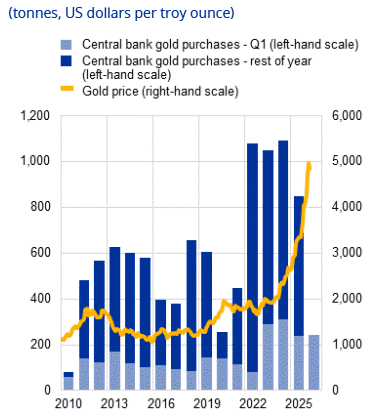
Source: European Central Bank, The international role of the euro, June 2026, Chart 6, panel a).
I should be honest that gold has not been a straight line in 2026. It crossed five thousand dollars in January, set an intraday record above five and a half thousand, fell below four thousand by late June and has recovered to around four and a half thousand since. Anyone who bought the peak is underwater. Bull markets in this asset have always included thirty per cent drawdowns, including during the Weimar inflation, and managing that drawdown for clients is a different job from holding the position personally.
A country that cannot move energy cannot build anything, which is why energy security stopped being a background variable this year. Crude and liquids through the Strait of Hormuz averaged 4.9 million barrels a day in the second quarter, against 21.6 million in the fourth quarter of 2025. Saudi volumes through Bab el-Mandeb rose from 5.4 million to 8.1 million as barrels were rerouted through the East-West pipeline to Yanbu.
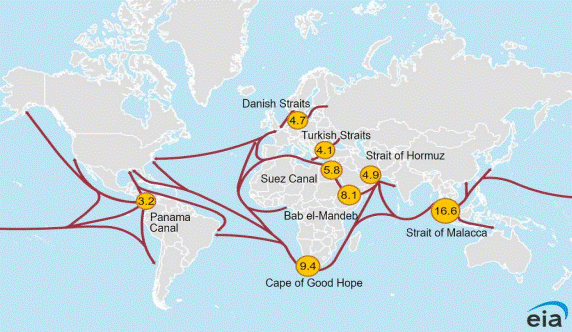
Source: US Energy Information Administration, Short-Term Energy Outlook, August 2026.
That rerouting is the whole framework in one chart. Nobody optimised for cost. Every government that watched it happen has since started paying for redundancy it did not previously think it needed, and redundancy is bought in physical things. It is also why the energy exposure in the fund leans towards producers and processing capacity rather than pure price exposure to crude, because the supply response to a shortage eventually arrives and the capacity built to handle it does not go away.
Reindustrialisation is a physical process before it is a financial one, and it stops at the power line. New factories, fabs, processing plants and data centres need generation, transmission and storage before they need anything else. That is why industrials, electrification and infrastructure are a meaningful part of the book. The defence exposure inside it is deliberately weighted towards Europe rather than the American primes, for the reason set out above. The incremental spending is happening outside the United States, and the American names have already re-rated a long way.
If Washington’s fiscal space is limited, the fiscal impulse has to come from somewhere else. The CBO projects a 5.8 per cent deficit for 2026, which constrains how much additional fiscal spending America can sustainably add. Countries that have relied on the American order for their security and energy are now shouldering more of the cost themselves. This is creating a favourable backdrop for non-US assets and supports the fund's exposure to regional equities outside the United States.
The way we take those positions follows from the framework as well. Outside the United States I take a view on the currency first and the underlying asset second, because in a world of competing state balance sheets the currency is where the policy shows up.
The largest country positions are Canada, Singapore, the United Kingdom and Japan, with smaller allocations to China, Argentina, Brazil, Turkey and emerging market dividend payers, and a small thematic exposure to Africa where the resource competition is heading. Singapore became a large position after the Iran war for a reason that goes directly to this framework. There used to be three genuinely neutral jurisdictions for capital. When Switzerland joined the sanctions on Russia in 2022 it took on a geopolitical premium it had not carried in two centuries. Neutrality is now a scarce asset, and it is priced accordingly. Latin America I like because it is too far from the great power contest to be drawn into it, and it has the energy, copper and agricultural resources that everyone else now wants.
Canada deserves a word given the rest of this piece. We built the position over the past three months, during the escalation rather than before it. A country with energy, potash, critical minerals, fresh water and an unavoidable border is not structurally impaired by a fifty per cent duty on five per cent of its exports to one customer, however unpleasant the next few quarters are. The tariffs reprice the relationship. They do not reprice the resource base.
The attempt has to be financed, and the post-war precedent tells you who pays. If the debt burden comes down through suppressed real rates and nominal growth rather than through austerity or default, then the long-dated government bond is the instrument through which the policy is funded. Its holder is the counterparty to the whole programme. We hold none. Cash and short-dated instruments form the defensive allocation, with a further portion of the portfolio in explicit hedges, including volatility.
Finally, capital that has to be spent on physical capacity cannot simultaneously be earning financialised returns. A sizeable portion of the fund is US quality and cash-flow oriented equity, held as ballast rather than growth. We own almost no American mega-cap technology and nothing in the AI complex directly, which has been a cost in some quarters. The United States is roughly a quarter of world GDP and around two-thirds of world market capitalisation. That gap does not need a crash to close. A long stretch of flat returns while other markets compound will do it, and there is precedent within living memory.
What would make me wrong
Reindustrialisation could actually work. If American capital investment lifts productivity, draws in foreign capital and supports a strong dollar with positive real rates, that combination is poor for gold and for most of what I have described. This is the largest risk to the thesis and it is not remote.
Politics could reverse it, through November, through the courts, or through both.
The themes could already be priced. Defence and power infrastructure have both re-rated substantially, and being right about the direction while wrong about the entry price is an ordinary way to lose money.
Energy could normalise faster than anyone expects. There has never been a shortage in history that was not eventually followed by abundance, and governments with sufficient incentive overinvest. If Hormuz reopens and the supply response arrives, the energy leg weakens quickly.
And the pace could escape the people managing it. Grant Williams made a point in conversation with Gromen that has stayed with me: it is fine for things to move in your direction at the pace you choose and dangerous when you lose control of that pace. This applies to the dollar, to the yen and to the long end of the Treasury curve.
Where this leaves me
Congress never enacted the bulk of the Report on Manufactures. Hamilton’s bounties were voted down, and he was dead within thirteen years. The framework won anyway over the following century, because the conditions that produced it did not go away and eventually the country stopped arguing with them.
That is roughly where we are. I am not forecasting that America rebuilds its industrial base, and I do not need to. What I am observing is that it has decided to try, that most of the rest of the world has decided the same thing about itself, and that the attempt must be paid for in real resources and in somebody’s purchasing power. Own the resources. Do not be the purchasing power.
Watch the long end of the Treasury curve. Watch gold against real rates. Watch what Ottawa and Washington do after Tuesday.
Those three will tell you whether this is a policy or a posture. I am positioned for a policy.
Disclaimer
This article is published by Pinetree Macro for informational and educational purposes only. It does not constitute investment advice, a recommendation, or an offer or solicitation to buy or sell any security or to invest in any fund, and it does not take account of the investment objectives, financial situation or particular needs of any reader. References to themes, asset classes, regions and approximate exposures describe the general orientation of the portfolio at a point in time and should not be read as a recommendation or as a complete statement of holdings. Past performance is not indicative of future results. All views expressed are as at 7 September 2026 and are subject to change without notice. Readers should conduct their own research and consult an appropriately licensed adviser before making any investment decision.