On 12 August 2026, Pinetree Macro completed four years. We have also crossed USD 50 million in assets under management and we are grateful for your support and trust.

Four years is long enough to have been wrong in public more than once, and long enough for the record to mean something. It felt like the right moment to look not only at what the strategy returned, but at the quality of the thinking that produced it.
Benchmarking the Thinking
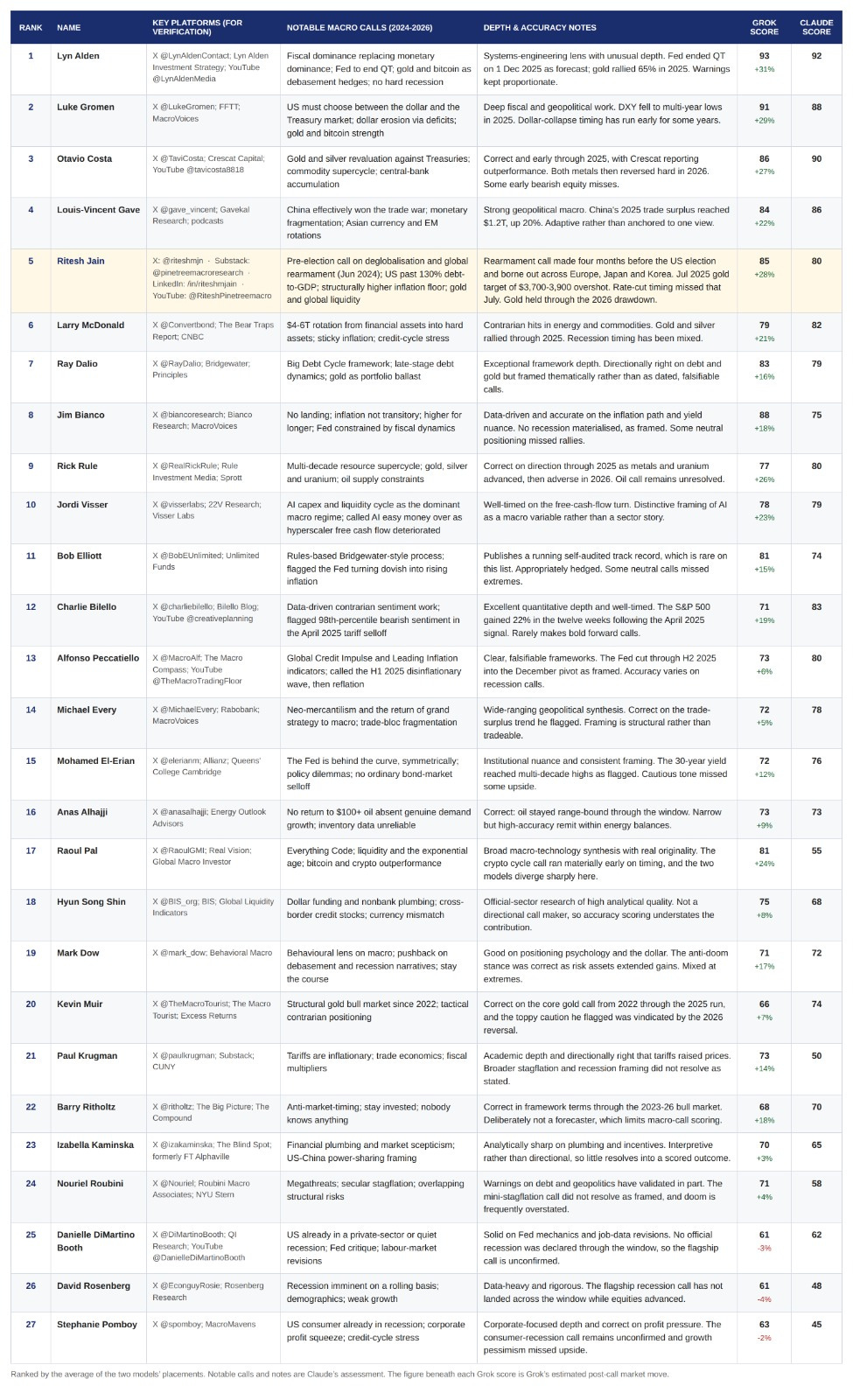
At four years we thought it worth benchmarking not only our performance but our thought process. In January we published a ranking of global macro commentators generated by Grok. This is the second iteration, and we have widened it to twenty-seven names and to two models.
Grok was used because it has native access to the X corpus and can reach the primary material directly. Claude was added because it approached the same question through a different lens, over different windows, and produced a materially different ordering. A second opinion that merely agrees is worth little. One that disagrees tells the reader something.
Each was asked to assess analytical depth and how closely public calls tracked what markets subsequently did. Both outputs are reproduced below.
Reading it honestly
We place fifth on the combined ordering. We are encouraged by that, and we want to be precise about what it does and does not establish.
The two models disagree, and not only about us. One placed Jim Bianco third and the other fourteenth. One had Charlie Bilello nineteenth and the other fifth. Raoul Pal sits ninth in one column and seventeenth in the other.
What is striking is how little of that gap the methodologies explain. Both models scored depth out of 50 and accuracy out of 50. Both looked at roughly the same two horizons, a four-year window running from late 2022 and a six-month window ending this September. The one structural difference is that Grok blends the horizons, weighting the long window at 70 per cent and the short one at 30, while Claude reports a single combined score.
The Liquidity Way of Investing
“Earnings don’t move the overall market; it’s the Federal Reserve Board... focus on the central banks, and focus on the movement of liquidity... most people in the market are looking for earnings and conventional measures. It’s liquidity that moves markets.”- Stanley Druckenmiller
Beneath the scores sits a single idea, and it is the idea we named our investment approach after.
Asset prices do not move in isolation. They are shaped by the broader environment in which capital is created, allocated and withdrawn. Earnings, valuations and narratives matter, but they operate within a larger force: the availability and direction of global liquidity.
This insight has long been central to our thinking. It is why we focus on central banks and the global flow of capital to understand the forces shaping markets. As Druckenmiller recognised decades ago, under the discipline of being measured by markets every day, liquidity is often the tide that ultimately determines where asset prices can go.
That is The Liquidity Way of Investing: understanding the tide before deciding which assets are most likely to benefit from it.
What we would rather be judged on
What we would rather point to is the framework behind the scores. In June 2024, four months before the US election, we wrote that an America-first administration would accelerate deglobalisation and push countries to fund their own defence as the American security umbrella was withdrawn. Rearmament across Europe, Japan and Korea has been among the defining themes since.
Note on methodology
1. Both models received an identical prompt, reproduced below, and assessed the same twenty-seven names over the same horizons. Neither output has been edited, and Pinetree Macro was scored on the same rubric as every other name.
2. Two windows were assessed: a four-year horizon running from late 2022, and a six-month horizon ending September 2026. It is worth noting that evaluating macro performance is inherently subjective. Unlike trackable stock picks, macro assessment relies on proxies such as semantic depth, meaning nuance, historical context and interconnected reasoning, and forecasting accuracy, measured by how well key calls on inflation, growth, rates, commodities, currencies and risk assets aligned with realised outcomes.
3. Both models score on the same basis, with Depth out of 50 and Accuracy out of 50 combined into a score out of 100. The one structural difference is that Grok blends the two horizons for its overall rank, weighting the four-year window at 70 per cent and the six-month window at 30 per cent, while Claude reports a single combined score.
4. The realised outcomes the models marked against, in Grok’s summary of the period: no US recession in 2023 and 2024, fiscal deficits that stayed large, gold as the winner of 2025 at plus 66 per cent on its figure, Bitcoin winning 2023 and 2024 and then lagging, and long bonds a hole through 2022 to 2024. Over the six-month window, the Warsh Fed, sticky inflation, gold chopping after the January spike, and the S&P 500 still near highs.
5. The post-call figure is Grok’s estimate of the market move following a given call. Claude did not produce a return estimate, so none is shown under its name. Both models publish the underlying sources, Grok as copy-paste X searches and Claude as a dated call log with live URLs, so that a third party can pull the same posts and check them against subsequent market data.
6. Prompt used for the analysis:
Go through the twitter, LinkedIn, YouTube, other publicly available sources feed possible of the following individuals of the last 6 months and the last 4 years to rank their macro analysis based on how their analysis of the world has panned out and how has their macro call performed in the markets over the same time period. Make a tabular presentation and also score them (0-100) the scoring should focus on Macro (Semantic Depth and Forecasting Accuracy Proxy).
Make table, rank their analysis and thought process and make it verifiable so that if someone asks grok to verify it on twitter, it is accepted. Make it as unbiased as possible and stick to how their calls have delivered returns in the markets. The calls should not only be whether they were correct or not but also factor in which call outperformed all others over the same time periods. Give an estimate on average market return post a call was given by them. This must remain unbiased and should purely focus their ability to forecast future macro regimes.
The individuals are: Luke Gromen, Raoul Pal, Lyn Alden, Larry McDonald, Jim Bianco, Otavio Costa, Louis Gave of Gavekal, Alfonso Peccatiello, Danielle DiMartino Booth, Stephanie Pomboy, David Rosenberg, Nouriel Roubini, Paul Krugman, Barry Ritholtz, Charlie Bilello, Bob Elliott, Mohamed El-Erian, Mark Dow, Hyun Song Shin, Jordi Visser, Kevin Muir, Ritesh Jain, Ray Dalio, Izabella Kaminska, Michael Every, Rick Rule, Anas Alhajji.
Four years in
We are pleased with the quality of our thinking, the accuracy of our calls and, most importantly, the journey we are on. Thank you for being part of this exciting journey in macro investing. We look forward to the next four years and all that lies ahead.
Disclaimer
The rankings and commentary in this article are generated by third-party large language models in response to a prompt written by Pinetree Macro. They are reproduced as returned. They represent model-generated interpretations of publicly available statements and are not the product of independent audit, verification or primary research by Pinetree Macro.
The scores and post-call figures shown are proxies. They are not audited performance records, not attributable returns, and not the returns of Pinetree Macro or any fund it manages. The methodology is subjective by construction, the outputs are not reproducible with certainty, and re-running the same prompt will produce different results.
The two models assessed different periods. Comparisons between their columns should be read with that in mind, and neither column should be treated as a like-for-like measure of the other. Rankings are model - generated and will change if the queries are re-run.
The individuals named have not participated in, reviewed, consented to or endorsed this exercise. Their inclusion reflects their public prominence in macro commentary and nothing more. No assessment of their professional competence, integrity or track record is intended or should be inferred, and nothing here should be read as a criticism of any named individual.
Nothing in this article constitutes investment advice, a recommendation, an offer or a solicitation to buy or sell any security or to invest in any fund. It does not take account of the objectives, financial situation or needs of any recipient. Past performance is not indicative of future results, and the value of investments can fall as well as rise. Readers should conduct their own research and consult a qualified adviser before acting.
Information is believed accurate as at the date of publication and is subject to change without notice. Pinetree Macro accepts no liability for any loss arising from reliance on this article.